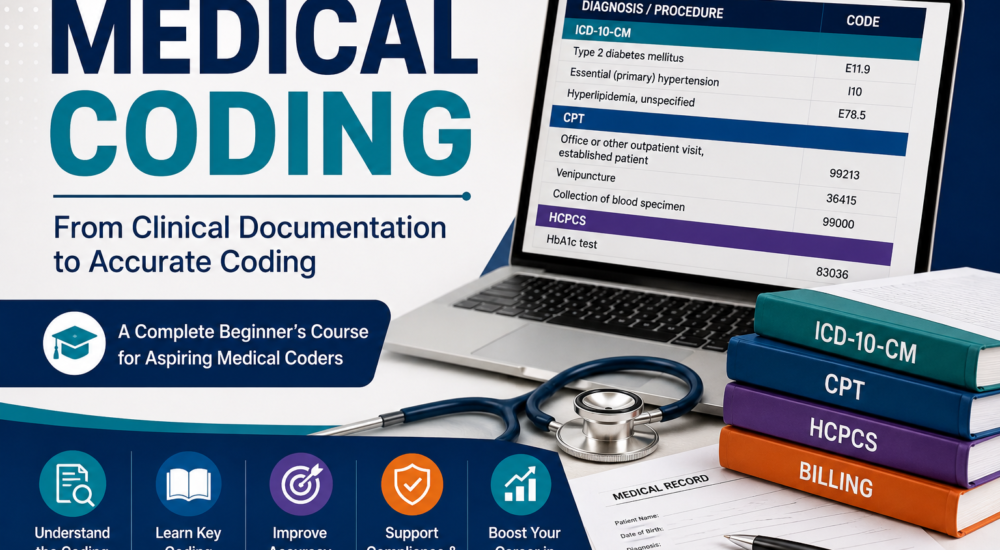
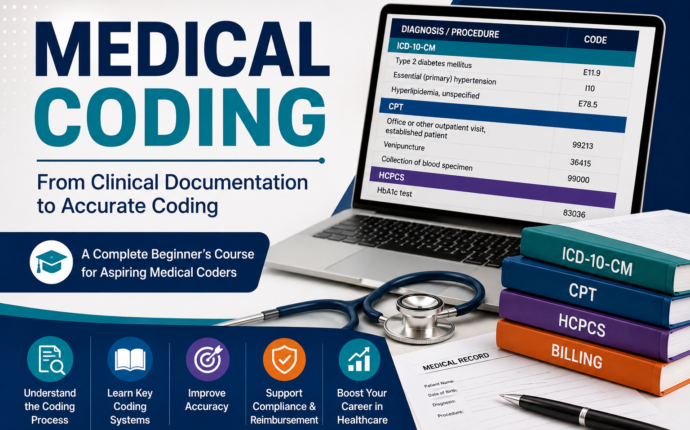
Medical Coding Fundamentals is an introductory course designed to help learners understand what medical coding is, how the coding process works, which coding systems are commonly used, and why coding accuracy matters in healthcare.
The course takes learners through the complete coding workflow, from reviewing clinical documentation to assigning standardized codes and understanding how coded information supports medical billing and healthcare administration.
This course is suitable for beginners, aspiring medical coders, healthcare administration professionals, medical billing professionals, and anyone who wants to understand the fundamentals of healthcare coding.
Course Information
Course Name: Medical Coding Fundamentals
Course Level: Beginner
Course Format: Online / Self-Paced
Course Category: Medical Coding & Healthcare Administration
Prerequisites: No prior medical coding experience required
Recommended Background: Basic understanding of healthcare terminology is helpful but not required.
Estimated Duration: 6-8 hours
Assessment: Quizzes, practical coding exercises, and final assessment
Certificate: Certificate of Completion upon successful completion
What You Will Learn
By the end of this course, learners will be able to:
- Explain what medical coding is and why it is important
- Describe the relationship between clinical documentation, coding, and billing
- Understand the basic medical coding process
- Identify common medical coding systems
- Explain the purpose of ICD-10-CM, CPT, and HCPCS
- Understand the difference between medical coding and medical billing
- Recognize common medical coding challenges
- Understand the responsibilities of a medical coder
- Identify the characteristics of accurate and compliant coding
- Explain how coding affects the healthcare revenue cycle
- Understand how technology and AI are being used in coding workflows
- Apply basic coding concepts to practical documentation examples
Course Curriculum
Module 1: Introduction to Medical Coding
Lesson 1.1: What Is Medical Coding?
Learn the basic definition of medical coding and understand how clinical information is converted into standardized codes.
Key topics:
- Definition of medical coding
- Purpose of standardized codes
- Clinical documentation
- Medical records
- Coding and healthcare administration
Lesson 1.2: Why Medical Coding Matters
Understand why coding is important to healthcare organizations, providers, payers, and patients.
Key topics:
- Claims
- Reimbursement
- Healthcare records
- Data reporting
- Revenue cycle
- Coding accuracy
Lesson 1.3: The Medical Coding Workflow
Understand the basic flow:
Medical Documentation → Code Assignment → Verification → Billing → Claim Processing
Activity: Identify each stage of the medical coding workflow.
Knowledge Check: 5-question quiz
Module 2: Understanding Medical Documentation
Lesson 2.1: Reading Clinical Documentation
Learn how medical coders review healthcare documentation to identify relevant clinical information.
Key topics:
- Patient medical records
- Diagnoses
- Procedures
- Treatments
- Symptoms
- Examinations
- Supporting documentation
Lesson 2.2: Identifying Reportable Information
Learn how coders determine which diagnoses and services are supported by documentation.
Lesson 2.3: Documentation Challenges
Understand how incomplete, unclear, or conflicting documentation can affect coding.
Practical Exercise: Review a sample clinical note and identify the diagnoses and services that may require coding.
Module 3: Medical Coding Systems
Lesson 3.1: ICD-10-CM Coding
Learn the basic purpose and application of ICD-10-CM.
Topics include:
- Diagnoses
- Diseases
- Injuries
- Symptoms
- Health conditions
- Basic code structure
Lesson 3.2: CPT Coding
Understand how CPT codes are used to describe many medical procedures and professional services.
Topics include:
- Medical procedures
- Professional services
- Office visits
- Diagnostic services
- Treatment services
Lesson 3.3: HCPCS Coding
Learn the basic purpose of HCPCS and how it is used for applicable healthcare services, procedures, supplies, and products.
Lesson 3.4: Comparing Coding Systems
Understand the basic differences between:
| Coding System |
Primary Purpose |
| ICD-10-CM |
Diagnoses and health conditions |
| CPT |
Many procedures and professional services |
| HCPCS |
Healthcare services, supplies, products, and other applicable items |
Knowledge Check: Coding-system identification quiz
Module 4: The Medical Coding Process
Lesson 4.1: Review the Medical Record
Learn how coders identify relevant information in clinical documentation.
Lesson 4.2: Identify Diagnoses and Services
Learn how documentation is analyzed to determine which conditions and services are supported.
Lesson 4.3: Select Appropriate Codes
Understand how coders use coding systems and applicable guidelines to select codes.
Lesson 4.4: Verify Coding Accuracy
Learn the importance of checking codes for:
- Accuracy
- Completeness
- Documentation support
- Consistency
- Applicable coding requirements
Lesson 4.5: Prepare Coded Information for Billing
Understand how completed coding becomes part of the information used to prepare healthcare claims.
Practical Exercise: Complete a simplified coding workflow using a sample patient encounter.
Module 5: Medical Coding and Medical Billing
Lesson 5.1: What Is Medical Billing?
Understand the basic role of medical billing and how it differs from coding.
Lesson 5.2: Coding vs. Billing
Medical Coding:
Clinical documentation → Standardized codes
Medical Billing:
Coded information + claim information → Claim submission → Reimbursement
Lesson 5.3: How Coding Affects Claims
Learn how incorrect or incomplete coding can contribute to:
- Claim errors
- Claim denials
- Payment delays
- Rework
- Incorrect reporting
Lesson 5.4: Understanding the Revenue Cycle
Follow the complete workflow:
Patient Care → Documentation → Coding → Billing → Claim Submission → Payer Processing → Payment → Denial Management
Activity: Map the role of the medical coder within the revenue cycle.
Module 6: What Does a Medical Coder Do?
Lesson 6.1: Medical Coder Responsibilities
Learn about common responsibilities, including:
- Reviewing medical records
- Identifying diagnoses
- Identifying procedures
- Assigning codes
- Applying coding guidelines
- Reviewing documentation
- Checking coding accuracy
- Identifying documentation questions
Lesson 6.2: Skills Required for Medical Coding
Explore the skills that support effective coding.
Important skills include:
- Attention to detail
- Medical terminology
- Anatomy knowledge
- Documentation interpretation
- Coding-system knowledge
- Research skills
- Analytical thinking
- Accuracy
Lesson 6.3: Quality and Accuracy
Understand why small documentation differences can affect code selection.
Knowledge Check: Medical coder responsibilities quiz
Module 7: Common Medical Coding Challenges
Lesson 7.1: Incomplete Documentation
Understand how missing information can make accurate code selection difficult.
Lesson 7.2: Complex Medical Records
Learn why multiple diagnoses, procedures, and services can increase coding complexity.
Lesson 7.3: Coding Errors
Understand common causes and potential consequences of coding errors.
Lesson 7.4: Changing Coding Requirements
Learn why coding professionals must stay current with applicable guidelines and requirements.
Lesson 7.5: High-Volume Coding
Understand the challenges associated with processing large numbers of medical records and claims.
Practical Exercise: Identify potential coding problems in sample documentation.
Module 8: Accurate Medical Coding
Lesson 8.1: What Makes Coding Accurate?
Learn the relationship between:
Documentation + Coding Guidelines + Correct Code Selection + Quality Review
Lesson 8.2: Benefits of Accurate Coding
Accurate coding can support:
- Better claims
- Fewer avoidable errors
- Smoother reimbursement workflows
- Better healthcare data
- Improved administrative processes
- Compliance support
Lesson 8.3: Quality Control
Understand the role of coding reviews, audits, and quality checks.
Activity: Perform a basic coding accuracy review using a sample case.
Module 9: Technology and AI in Medical Coding
Lesson 9.1: Technology in Coding
Explore how coding platforms and software support modern coding workflows.
Lesson 9.2: Coding Automation
Understand how technology can assist with:
- Documentation review
- Code lookup
- Workflow management
- Quality checks
- Data analysis
Lesson 9.3: AI-Assisted Coding
Learn how artificial intelligence can identify potential codes and documentation patterns.
Lesson 9.4: Human Review and Oversight
Understand why technology does not eliminate the need for qualified human review.
Key Principle:
Technology can assist the coding process, but accurate coding still depends on reliable documentation and appropriate human oversight.
Module 10: Medical Coding in the Real-World Revenue Cycle
Lesson 10.1: From Patient Encounter to Payment
Follow a patient encounter through the complete process:
Patient receives care
↓
Provider documents care
↓
Medical coder reviews documentation
↓
Codes are assigned
↓
Biller prepares the claim
↓
Claim is submitted
↓
Payer processes the claim
↓
Payment or denial
Lesson 10.2: Where Coding Problems Create Downstream Issues
Understand how a coding problem can affect later stages of the revenue cycle.
Lesson 10.3: Building an Effective Coding Workflow
Learn why documentation, coding, billing, quality control, and denial management need to work together.
Case Study: Analyze a simplified end-to-end revenue cycle scenario.
Module 11: Medical Coding Services and Outsourcing
Lesson 11.1: What Are Medical Coding Services?
Understand what specialized medical coding service providers do and why healthcare organizations may use them.
Lesson 11.2: When Organizations Consider Outsourcing
Explore factors such as:
- Coding volume
- Staffing
- Specialty requirements
- Internal expertise
- Operational capacity
- Quality control
Lesson 11.3: Internal vs. Outsourced Coding
Compare the considerations involved in managing coding internally versus using an external coding service.
Activity: Evaluate a fictional healthcare organization and determine which approach may be appropriate.
Module 12: Practical Medical Coding Exercises
This module brings together concepts from the course.
Exercise 1: Documentation Review
Review a sample medical record and identify relevant diagnoses and services.
Exercise 2: Coding-System Selection
Determine whether a scenario relates primarily to ICD-10-CM, CPT, or HCPCS.
Exercise 3: Coding Workflow
Place the stages of the coding and billing process in the correct order.
Exercise 4: Error Identification
Identify potential documentation or coding problems in sample scenarios.
Exercise 5: Revenue Cycle Case Study
Analyze how a coding issue could affect claim submission and reimbursement.
Final Assessment
The final assessment evaluates the learner’s understanding of the core concepts covered throughout the course.
Assessment Areas
- Medical coding fundamentals
- Medical documentation
- ICD-10-CM
- CPT
- HCPCS
- Coding workflow
- Medical coding vs. billing
- Medical coder responsibilities
- Coding accuracy
- Revenue cycle
- Coding challenges
- Technology and AI
- Medical coding services
Recommended Passing Score: 80%
Learners who successfully complete the course and meet the required assessment criteria may receive a Certificate of Completion.
Course Completion Skills
After completing the course, learners should be able to:
- Explain the purpose of medical coding.
- Describe how medical documentation becomes standardized coding information.
- Identify the basic purposes of ICD-10-CM, CPT, and HCPCS.
- Explain the difference between medical coding and medical billing.
- Describe the responsibilities of a medical coder.
- Recognize common coding challenges.
- Explain why accurate coding matters.
- Describe how coding supports the healthcare revenue cycle.
- Explain how technology and AI can assist coding workflows.
- Apply basic coding concepts to simplified healthcare scenarios.
Frequently Asked Questions
Is this course suitable for beginners?
Yes. The course starts with the fundamentals and gradually introduces coding systems, workflows, and practical applications.
Do I need previous medical coding experience?
No. Previous coding experience is not required.
Will this course teach ICD-10-CM and CPT?
The course introduces the purpose, structure, and basic application of ICD-10-CM and CPT. Learners who want professional-level coding proficiency will need more advanced training and hands-on practice.
Is medical coding the same as medical billing?
No. Coding converts clinical documentation into standardized codes, while billing uses coded information and other claim data to manage healthcare claims and reimbursement.
Can medical coding be outsourced?
Yes. Healthcare organizations may use external medical coding services depending on their staffing, specialty, coding volume, expertise, and operational requirements.
Does this course qualify someone to work as a professional medical coder?
Completion of an introductory course alone does not necessarily qualify someone for professional coding work or certification. Professional roles may require additional education, experience, employer-specific requirements, or recognized certification.
Suggested Learning Path
Module 1: Medical Coding Fundamentals
↓
Module 2: Medical Documentation
↓
Module 3: Coding Systems
↓
Module 4: Coding Process
↓
Module 5: Medical Billing & Revenue Cycle
↓
Module 6: Medical Coder Role
↓
Module 7: Coding Challenges
↓
Module 8: Coding Accuracy & Quality
↓
Module 9: Technology & AI
↓
Module 10: Real-World Revenue Cycle
↓
Module 11: Medical Coding Services
↓
Module 12: Practical Exercises
↓
Final Assessment
↓
Course Completion
Final Course Message
Medical coding is more than assigning numbers to medical records. It is a structured process that connects clinical documentation with billing, reimbursement, reporting, and healthcare administration.
Accurate coding depends on three essential elements:
Clear Documentation + Correct Coding + Quality Review
This course provides the foundation learners need to understand that process and prepare for more advanced medical coding education and practical training.