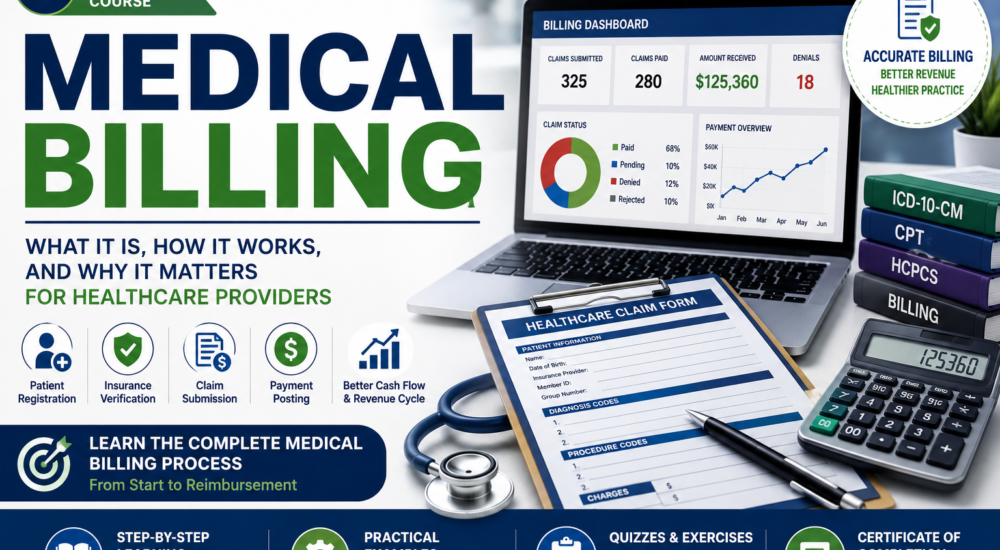
Medical Billing Fundamentals is a beginner-friendly course designed to teach learners how healthcare billing works from the initial patient registration through insurance verification, claim submission, payment posting, and denial management.
The course explains the relationship between medical billing, medical coding, insurance claims, and the healthcare revenue cycle. Learners will also explore common billing challenges, billing technology, outsourcing, and practical billing scenarios.
Course Level: Beginner
Format: Online / Self-Paced
Estimated Duration: 6-8 Hours
Prerequisites: No prior medical billing experience required
Assessment: Module quizzes, practical exercises, case study, and final assessment
Certificate: Certificate of Completion
What You Will Learn
By the end of this course, learners will be able to:
- Explain what medical billing is and why it matters
- Describe the complete medical billing process
- Understand patient registration and insurance verification
- Explain the role of medical coding in billing
- Understand charge entry and claim submission
- Describe how insurance companies process claims
- Understand payment posting and account reconciliation
- Identify common causes of claim denials
- Explain denial management and billing follow-up
- Distinguish medical billing from medical coding
- Understand how billing affects the healthcare revenue cycle
- Identify common billing errors and challenges
- Understand the role of technology in medical billing
- Explain the purpose of professional medical billing services
- Apply basic billing concepts to practical healthcare scenarios
Course Curriculum
Module 1: Introduction to Medical Billing
Lesson 1.1: What Is Medical Billing?
Learn the fundamentals of medical billing and understand how healthcare services are converted into claims and reimbursement.
Key topics:
- Definition of medical billing
- Purpose of medical billing
- Healthcare claims
- Insurance companies and payers
- Provider reimbursement
- Revenue cycle management
Lesson 1.2: Why Medical Billing Matters
Understand how billing affects the financial operations of healthcare organizations.
Learn how accurate billing can help:
- Reduce payment delays
- Minimize claim errors
- Improve cash flow
- Reduce administrative rework
- Support accurate financial records
- Improve revenue cycle performance
Lesson 1.3: The Medical Billing Cycle
Understand the complete process:
Patient Registration → Eligibility Verification → Coding → Charge Entry → Claim Submission → Claim Processing → Payment Posting → Denial Management
Knowledge Check: 5-question introductory quiz
Module 2: Patient Registration
Lesson 2.1: Patient Registration Fundamentals
Learn how accurate patient information is collected before healthcare services are billed.
Key Information
- Patient name
- Date of birth
- Contact information
- Address
- Insurance provider
- Member ID
- Policy information
- Provider information
Lesson 2.2: Why Accurate Registration Matters
Understand how incorrect demographic or insurance information can create downstream billing problems.
Common problems include:
- Incorrect patient information
- Incorrect insurance details
- Duplicate records
- Claim rejection
- Payment delays
Practical Exercise
Review a sample patient registration form and identify missing or potentially incorrect information.
Module 3: Insurance Eligibility and Verification
Lesson 3.1: What Is Insurance Eligibility Verification?
Learn how billing teams verify whether a patient’s insurance coverage is active and applicable to the planned service.
Lesson 3.2: What Should Be Verified?
Explore:
- Insurance status
- Member information
- Coverage dates
- Benefits
- Patient responsibility
- Coverage limitations
- Prior authorization requirements
- Provider participation
Lesson 3.3: Common Eligibility Problems
Learn how inactive coverage, incorrect member information, and authorization issues can affect claims.
Practical Exercise: Analyze sample insurance verification results and identify potential billing risks.
Module 4: Medical Coding and Billing
Lesson 4.1: What Is Medical Coding?
Understand how clinical documentation is converted into standardized medical codes.
Lesson 4.2: Why Coding Matters to Billing
Learn how coding information becomes part of the data used to prepare and submit healthcare claims.
Lesson 4.3: Medical Billing vs. Medical Coding
Medical Coding:
Clinical documentation → Standardized medical codes
Medical Billing:
Coded information → Claim preparation → Claim submission → Payment management
Lesson 4.4: Coding Errors and Billing Problems
Understand how inaccurate coding can contribute to:
- Claim rejections
- Claim denials
- Payment delays
- Incorrect reimbursement
- Additional administrative work
Knowledge Check: Coding vs. billing quiz
Module 5: Charge Entry
Lesson 5.1: What Is Charge Entry?
Learn how healthcare services, procedures, charges, and coded information are entered into a billing system.
Lesson 5.2: What Makes Accurate Charge Entry Important?
Understand why charges should be consistent with:
- Medical documentation
- Assigned codes
- Services provided
- Payer requirements
Lesson 5.3: Common Charge Entry Errors
Explore examples such as:
- Missing charges
- Incorrect charges
- Duplicate entries
- Incorrect codes
- Incorrect patient information
Practical Exercise: Review a sample charge entry record and identify potential errors.
Module 6: Medical Claim Submission
Lesson 6.1: What Is a Medical Claim?
Learn what a healthcare claim is and why it is submitted to a payer.
Lesson 6.2: Preparing a Clean Claim
Understand the importance of accurate:
- Patient information
- Insurance information
- Provider information
- Diagnosis codes
- Procedure codes
- Charges
- Supporting documentation
Lesson 6.3: Electronic Claim Submission
Learn the basics of electronic claims and why electronic submission is commonly used in healthcare billing.
Lesson 6.4: Claim Rejections vs. Claim Denials
Understand the difference between a rejected claim and a denied claim.
Activity: Determine whether sample claim scenarios represent rejection or denial.
Module 7: Claim Processing
Lesson 7.1: What Happens After Claim Submission?
Follow the claim as it moves from the healthcare provider to the payer.
Workflow:
Claim Submitted → Payer Receives Claim → Claim Reviewed → Adjudication → Payment, Denial, or Additional Action
Lesson 7.2: Understanding Claim Adjudication
Learn how payers evaluate claims against coverage, coding, documentation, and other applicable requirements.
Lesson 7.3: Common Claim Processing Outcomes
Claims may result in:
- Payment
- Partial payment
- Denial
- Rejection
- Request for additional information
- Patient responsibility
Knowledge Check: Claim processing assessment
Module 8: Payment Posting
Lesson 8.1: What Is Payment Posting?
Learn how payments received from insurance companies and patients are recorded in the billing system.
Lesson 8.2: Understanding Adjustments
Explore how billing systems record applicable adjustments, contractual amounts, and patient responsibility.
Lesson 8.3: Account Reconciliation
Understand why posted payments should be compared with expected claim outcomes.
Lesson 8.4: Common Payment Posting Problems
Learn how posting errors can affect:
- Account balances
- Patient statements
- Accounts receivable
- Financial reporting
Practical Exercise: Complete a simplified payment-posting scenario.
Module 9: Denial Management and Follow-Up
Lesson 9.1: What Is a Claim Denial?
Understand what happens when a payer does not approve a claim for payment as submitted.
Lesson 9.2: Common Reasons for Denials
Explore common causes such as:
- Incorrect patient information
- Eligibility problems
- Coding issues
- Missing documentation
- Authorization problems
- Duplicate claims
- Payer-specific requirements
Lesson 9.3: Denial Investigation
Learn how billing teams identify the reason for a denial and determine the appropriate next step.
Lesson 9.4: Correcting and Resubmitting Claims
Understand when a claim may need correction, additional documentation, reconsideration, or other follow-up.
Lesson 9.5: Tracking Denial Trends
Learn why organizations analyze denial patterns instead of treating every denial as an isolated event.
Case Study: Investigate a denied claim and determine the likely cause and next action.
Module 10: Medical Billing and the Revenue Cycle
Lesson 10.1: What Is the Healthcare Revenue Cycle?
Understand the complete financial process surrounding healthcare services.
Revenue Cycle Workflow
Patient Registration
↓
Insurance Verification
↓
Patient Receives Care
↓
Medical Documentation
↓
Medical Coding
↓
Charge Entry
↓
Claim Submission
↓
Claim Processing
↓
Payment Posting
↓
Denial Management
↓
Accounts Receivable Follow-Up
Lesson 10.2: Where Billing Problems Occur
Learn how problems at one stage can create problems later in the revenue cycle.
For example:
Incorrect Registration → Claim Problem → Payment Delay → Additional Follow-Up
Lesson 10.3: Measuring Billing Performance
Explore basic revenue cycle indicators such as:
- Claim accuracy
- Denial rate
- Accounts receivable
- Payment turnaround
- Outstanding balances
- Collection performance
Module 11: Common Medical Billing Challenges
Lesson 11.1: Claim Denials
Understand why denials occur and why organizations need structured denial-management processes.
Lesson 11.2: Data Entry Errors
Learn how inaccurate patient and insurance information can affect claims.
Lesson 11.3: Delayed Payments
Understand why some claims take longer to process or resolve.
Lesson 11.4: Changing Payer Requirements
Learn why different payers may have different billing rules and requirements.
Lesson 11.5: High Claim Volumes
Understand the operational challenges of processing large numbers of claims.
Activity: Identify the billing problem in five sample scenarios.
Module 12: Medical Billing Services
Lesson 12.1: What Are Medical Billing Services?
Learn what specialized billing providers do and how they support healthcare organizations.
Services may include:
- Insurance verification
- Claim submission
- Payment posting
- Accounts receivable follow-up
- Denial management
- Claim status tracking
- Billing reporting
- Revenue cycle support
Lesson 12.2: Why Healthcare Organizations Outsource Billing
Explore reasons organizations may consider outsourcing, including:
- Staffing limitations
- High claim volumes
- Specialized requirements
- Operational efficiency
- Access to billing expertise
- Technology requirements
Lesson 12.3: Choosing a Medical Billing Company
Understand factors organizations may evaluate when selecting an external billing partner.
Consider:
- Experience
- Specialty knowledge
- Technology
- Security practices
- Reporting
- Communication
- Quality controls
- Pricing structure
Case Study: Evaluate two hypothetical medical billing providers.
Module 13: Technology in Medical Billing
Lesson 13.1: Medical Billing Software
Understand how billing platforms support healthcare organizations.
Common Functions
- Patient account management
- Claim creation
- Electronic claim submission
- Payment posting
- Claim tracking
- Reporting
- Denial management
Lesson 13.2: Automation
Learn how automation can reduce repetitive administrative tasks.
Examples include:
- Automated eligibility verification
- Electronic claim submission
- Claim-status tracking
- Payment processing
- Denial alerts
- Reporting
Lesson 13.3: AI in Medical Billing
Understand how artificial intelligence may assist with:
- Identifying potential claim issues
- Reviewing billing information
- Predicting denial risks
- Automating repetitive workflows
- Analyzing billing data
Technology can improve efficiency, but human review remains important for complex cases and exceptions.
Module 14: Practical Medical Billing Workshop
This module brings the course concepts together through realistic scenarios.
Exercise 1: Patient Registration
Review a patient record and identify missing registration information.
Exercise 2: Insurance Verification
Determine whether the available insurance information creates potential billing risks.
Exercise 3: Claim Preparation
Review a simplified claim and identify potential errors before submission.
Exercise 4: Claim Status
Analyze a claim status and determine the appropriate next step.
Exercise 5: Payment Posting
Review a payment record and identify how it should be reflected in the patient’s account.
Exercise 6: Denial Management
Analyze a denied claim, identify the likely reason, and determine the appropriate follow-up action.
Exercise 7: Revenue Cycle Case Study
Follow one patient account through:
Registration → Verification → Coding → Billing → Claim → Payment → Denial Management
Module 15: Final Assessment
The final assessment evaluates the learner’s understanding of the complete medical billing process.
Assessment Areas
- Medical billing fundamentals
- Patient registration
- Insurance verification
- Medical coding
- Charge entry
- Claim preparation
- Claim submission
- Claim processing
- Payment posting
- Denial management
- Revenue cycle
- Medical billing services
- Billing technology
Recommended Passing Score: 80%
Learners who successfully complete the course and meet the required assessment criteria may receive a Certificate of Completion.
Course Completion Skills
After completing this course, learners should be able to:
- Explain the purpose of medical billing.
- Describe the complete medical billing workflow.
- Explain the importance of accurate patient registration.
- Understand insurance eligibility verification.
- Explain how medical coding supports billing.
- Describe the basic claim submission process.
- Understand claim processing and adjudication.
- Explain payment posting and account reconciliation.
- Identify common causes of claim denials.
- Describe basic denial-management procedures.
- Explain how billing fits into the healthcare revenue cycle.
- Identify common medical billing challenges.
- Understand the role of medical billing services.
- Explain how technology and automation support billing.
- Apply basic billing concepts to real-world scenarios.
Suggested Learning Path
Module 1: Introduction to Medical Billing
↓
Module 2: Patient Registration
↓
Module 3: Insurance Verification
↓
Module 4: Medical Coding & Billing
↓
Module 5: Charge Entry
↓
Module 6: Claim Submission
↓
Module 7: Claim Processing
↓
Module 8: Payment Posting
↓
Module 9: Denial Management
↓
Module 10: Revenue Cycle
↓
Module 11: Billing Challenges
↓
Module 12: Medical Billing Services
↓
Module 13: Technology & Automation
↓
Module 14: Practical Workshop
↓
Module 15: Final Assessment
↓
Certificate of Completion
Frequently Asked Questions
Is this medical billing course suitable for beginners?
Yes. The course starts with basic concepts and progressively introduces the major stages of healthcare billing.
Do I need previous medical billing experience?
No. The course is designed for beginners and does not require prior professional billing experience.
Will I learn medical coding in this course?
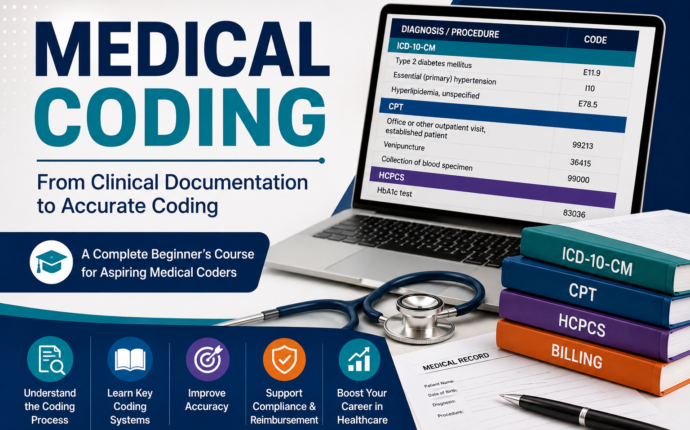
You will learn how medical coding fits into the billing process and why coding accuracy matters. This is a medical billing course, not an advanced medical coding certification program.
Will this course teach me how to submit claims?
The course explains the claim preparation and submission workflow and provides practical exercises using simplified scenarios.
Will I learn denial management?
Yes. Denial management is a major part of the course. You will learn common denial causes, investigation, correction, follow-up, and basic denial analysis.
Can medical billing be outsourced?
Yes. Healthcare organizations may outsource some or all billing functions to specialized medical billing service providers.
Does completing this course qualify me for a medical billing job?
An introductory course can provide foundational knowledge, but it does not automatically qualify someone for every medical billing position. Employers may require additional training, experience, software knowledge, or other qualifications.
Final Course Message
Medical billing is not simply about submitting claims. It is a connected process that begins with accurate patient information and continues through insurance verification, coding, charge entry, claim submission, payment posting, and denial management.
The strongest billing workflows focus on the entire revenue cycle rather than treating each billing task separately.
Accurate Information → Clean Claims → Effective Follow-Up → Timely Reimbursement → Stronger Revenue Cycle